Showing posts with label Process. Show all posts

10.09.2010

Existentialism and a Pretty Flower

A little existentialism if you please.  Is art about execution or idea?  As a practitioner of a heavily technical medium I'm inclined towards former, but as an artist I'm inclined toward the latter.  For visual artists it's an important question to consider.  I feel non-visual mediums don't suffer as much from this, a poorly written and preformed piece of music is instantly recognizable, as is bad writing as well as poor acting.  Yet in the visual media one is almost always forced to describe in words what the point is, why this particular stroke of color or that symbolic metaphor.  The first minute of Bach's Suite for Cello leaves me breathless, and yet I've never read his personal interpretation of it.  Is it the responsibility of the artist to do so, or not.  Shouldn't the idea behind the work be clear if the execution was well executed.  Or does it help the viewer understand a deeper, more personal meaning if the artist expands on the idea verbally.  Visiting modern art shows, in all mediums, I sometimes get the feeling well crafted pieces are brushed aside as merely that.  That somehow, complete control of the tools will invariably inhibit the free expressive use of them.  This bothers me because unsubstantiated ideas are cheap and prolific.  It takes beautiful execution in your chosen medium to portray that idea with grace.  I'm a proponent of understanding every nuance of the tools you use to create your work.  Chance favoring the prepared mind.  I recently carved a didgerdoo while on vacation and when deciding on it's surface finish I came across an article talking about how the native Aboriginals of Australia have no distinction between art and craft, they are one in the same.  Perhaps only when execution and idea meld together does true art become made.  No words, no descriptions, no eloquent debates, just the inevitable magnifying glass that true art holds against the self, the species and the world.

So with that, here's a non-existential pretty flower to brighten your Sunday!
Cheers all!

5.24.2010

The Pursuit of Knowable Excellence

One of my favorite photographic publications is a little known magazine called Lenswork.  It focuses solely on ideas rather than the technicals of photography.  Its editor, Brooks Jensen, does an outstanding job of selecting a myriad of portfolios to showcase each issue.  In the beginning of each publication he adds an editors note, which typically talks on a creative aspect within the medium of photography.  The lastest issue, #88, he expounded on an interesting idea I never fully embraced before, at least not from this perspective.  Excellence.  More specifically what is your personal approach to it.  Is it in the subtle play of print tones, the subject matter, the coverage or final presentation.  If the image content is the excellence than a carefully crafted physical print may be a moot point for you.  On the other hand, if beautiful tonality, rich in interplay is important than the final print is the pinnacle of your excellence.  It's a refreshing way to look at an unknown artists work.  Rather than ask yourself if you like an artists work, understand it or agree with it, ask yourself what's the artists definition of excellence.  Looking inward, my initial response to my own pursuit of excellence lies in showing you a feeling about yourself through my work.  Literal accuracy, coverage, even place doesn't really matter.  My aim is to have you feel the quiet of desert, the chill of night or some unknown memory that only you have that is drawn out through one of my images.  After my initial response though I find myself adding little things that I feel add to my pursuit of excellence.  A well exposed negative, two portfolio quality images on a single roll of 120, well crafted print tonalities, sharp image scans, excellence in technical execution, knowing exactly how an image was shot.  I guess I have a few definitions for myself, but I've never liked single responses anyway.  What's your pursuit(s) of excellence?
...go shoot an image, it's fun.

4.27.2010

The Truffle

In my ever present quest to learn more about architecture and design, to help me be a better architecture photographer, I'm constantly becoming inspired by cool creative that permeates the industry.  This structure is no exception.  I won't detail it here because they did a fantastic job of outlining the project on the website below.  So look, explore and get inspired by a very neat building.  Cheers all!

The Truffle House Link

                                                                    © Roland Halbe

3.30.2010

Architecture Design | and all that

A whirlwind of activity over the past several weeks has yielded a substantial new portfolio, a fresh direction, new clients, and a healthy respect for design.  Heavily focusing on a single photographic subject forces you to evaluate it in extreme detail, to learn its' subtle nuances, to see it in a light that perhaps is unconsciously ignored by the passerby.  Until I started to truly look at architecture through my lens, with eyes honed from years of patiently photographing the landscape, I failed to appreciate the level of manufactured grace that comes from the understanding of space and how to fill it with man-made constructs.  I've come to be inspired by something that compositionally resembles the natural world, but otherwise is the exact opposite.  I now see architecture as a three dimensional canvas that has two very different, yet symbiotic, functions.  It must be usable, and at the same time visually powerful.  The space must tell a story, whatever that story may be is up to the architect.  Perhaps it's one of integration into the surroundings, or a narrative on the use of sustainable materials.  I see it, as an architectural photographer, to capture all these things in two very simple dimensions.  To show the viewer the power of a building or beauty of a space, to communicate the architects intent.  I love my job.

2.09.2010

How I Shot It - "Rialto Beach Study No.1"

The Olympic Coastline in Washington State has some of the most rugged and wild scenery along the entire length of the West Coast.  Little houses, no resorts, few access points, thick forests extending down to the high tide line, it's a landscape photographers paradise.  My good buddy Patrick (see his work here) and I had been photographing the parks interior for most of the day, along the Hoh River Valley, which is equally wild with the thickest vegetation outside the Brazilian Rainforest's.  Rialto Beach faces almost directly West, and we knew the Sun's setting angle and thus decided to head here over some of the other spots.  There are so many seastacks along this stretch of coastline I could get lost for months photographing them.  We jumped out of the car and knew we were in for a treat, the sun was 45 minutes from setting and we had to hike about two miles to get to the spot we wanted.  For those of you who have seen Washington's Coast you know how rocky it can get, this place was no exception.  None the less we strapped our gear and started humping it up the beach.  We rolled onto the scene and parted ways, as we usually do, which makes shooting together so enjoyable. We each have our own vision of what the scene can offer.  As the sun set I made several exposures of some surrounding seastacks, but wasn't satisfied.  As I walked further on this seastack, which from the side was shaped something like a huge upside down 'V', turned out to be quite narrow when viewed head on.  The sun had been set for over 30 minutes and so I was beginning to chase the last of the light.  I wanted the color to be soft and shift cyan and so loaded color negative instead of chrome film in my camera back.  I also wanted the water to soften quite a bit, to really focus all attention of the shape of the seastack.  I used a 3 stop ND filter to lengthen the exposure time which ended up being close to three minutes with reciprocity.  The sky was a nice surprise.  I didn't notice that it was flowing parallel to the shore, reinforcing the attention to the rocks.  This has consistently been one of my favorite images I've shot.  

2.05.2010

Interpratation not Replication

I've never liked the word belief, it's used to back fallacious arguments and close the door on open discussion.  So I'm not going to use it here, but instead use 'opinion', which hopefully will invite some discussion.  One of my opinions is photographic art is about interpretation not replication, which for me equates to snapshots.  A snapshot is just that, a frozen replicated moment, shot to reinforce the future memory of the event.  Art is as much about the artist as it is their medium.  I was in the National Gallery in Washington DC a few years back and under a series of stunning Monet paintings was a little plaque with a quote from him, "what I want to reproduce is what exists between the motif and me".  Photography has always been an outsider in the realm of the visual fine arts.  It's the one medium most everybody participates in.  And yet photographic artists are constantly being chided for over manipulation.  The comments, is this Photoshop'd, how's this manipulated, did it look like that in real life, and so forth abound during all photo discussions.  This is even evident on the photographers side, I've been in numerous galleries that stress how the images shown are as close to replicating the scene as possible, or how no filters were used, etc.  I could care less how an image was produced.  I like the final.  I want to feel what the photographer did, not see what he saw.  Show me more than a mere replication, show me your interpretation.  Because lets be real, all photography is manipulation, and I mean all.  Every photographic decision is a departure from reality; from shutter speed to saturation.  When a viewer once came rushing up to Ansel and said my god your images are so realistic, he simply laughed and so no, they are not.  The sky was not black, these images are how I felt, not what I saw.  That's right on.  So burn, dodge, add contrast, saturation to your hearts content.  Stand out and show your interpretation of what you saw, not simply what was there. 

2.03.2010

Vintage is the New Hip

If you read yesterdays post this is going to be the exact opposite, a departure from the fantastical technology headed our way.  There's a deep duality with me, I fully embrace the coolness of modern technology, and where it's heading and yet at the same time my deepest fantasy is to build a rustic mountain(or desert) cabin, furnish it with hand built furniture, stock it with produce grown form my garden and meat hunted.  To watch the quiet sunrise, far removed from the city where I now live.  To live as close to nature as possible, to observe first hand the changing of the seasons and the running of the deer (past piece).  If you know me you know I love to build things.  I have much more fun building something than using it, most recently I carved and built a model sailboat, which has been sailed exactly once. 
I'm definitely a journey/process versus destination guy.  So my next project is going to be a camera, a large 20x20 wooden camera, complete with a handmade lens and film holders.  Why so large, well I plan on shooting wax paper and collodion negatives contact printed on a variety of prepared surfaces, but I'm most excited about salt prints. 
Contact printing is sandwiching the negative and paper together in a glass frame and exposing it to UV light.  The size of the final print is equal to the size of the negative.  I'd like to exhibit the final work along side the materials used to produce it.  I've always had this feeling when visiting art galleries, when there is a plethora of information 'defending' the process by which the particular photographer achieved the images, that if what's being sold is the process than the process should also be on display.  Plus it would be really fun to describe the whole project, from building the camera to producing the final images.  Handmade throughout, no computers, pixels or inks.  Sometimes disconnecting is the best thing you can do.  Yes I know I'm writing a post about handmade on a computer, but hey what'd you expect, a handwritten blog post.  Ooh, now there's an idea, a snail mail blog, but then it wouldn't be called a blog but a snog (snail + log), of course I already use the word snog at Christmas time, Soy Eggnog; snog...

Cheers All!

2.02.2010

Avatar is Only the Beginning

The name aside, the iPad represents something perhaps more profound.  It wasn't that long ago that an internal single gigabyte hard drive cost well over 4000K, and you had to insert a 'boot-up' disk in order to run anything.  I'm not that old and I can vividly recall a time before the Internet, a fact my future children will chide me for I'm sure.  Yes I am well aware that Apple isn't the first company to produce a tablet computer, but lets face it Apple takes things to another level of design, use, integration and coolness.  Already periodical publishing companies are lining up to get their subscriber based content fed through it.  Will it be their savior, only times will tell, but I'm getting away from myself.  At the same time Apple was developing this device, which I'm sure has been in the works for years, a director by the name of James Cameron was developing the technology to bring his latest piece to the screen.  Spending millions he developed the most complex 3D production equipment to date, and if worldwide sales are any indication people love it.  3D isn't new, but the quality has vastly improved from the early beginnings decades ago.  And with Sony and Panasonic announcing a line of home 3D television sets, ready for shipment sometime this year, is this the way media is headed.  I wonder how a 3D photography gallery would fare.  When you walk in you're handed glasses, like the ones you're given in the theater today, and wander huge three dimensional pieces that jump off the wall at you, as if you're walking through a desert sunrise or a Yosemite snowstorm.  Attached to these glasses could be earphones with digital recordings made by the photographer at the moment of capture, to transport you even deeper into the environment, losing yourself in the 3 dimensional beauty.  Or perhaps one step further, since motion capture and still capture are now being produced via the same devices, each frame is a moving 3D landscape, with sound.  Fantastical, perhaps, but not very far off.  If the point of landscape art is to transport your viewer, this scenario seems like a sure way to get them deeper into your creative.  And for me, if BW could be produced this way, what an experience that would be.  I'm very excited about these things, very different than whats come before.  With technology changing as fast as it is, who knows what Avatar has started, all I know is it's only the beginning.

2.01.2010

How I Shot It - "Shack with Clouds"


I tried meditating, nothing.  I tried exercising, nothing.  So I turned to the one thing that calms me the most, photographing, and left.  I had to get out for a bit, had to disappear into my work and not talk to anyone.  I had about an hour and a half before I had to be back or there would be one very confused young lady.  So without a word I grabbed my camera bag and took off for the countryside.  It was early October and today I was getting married.  We were buried in the mountainous hills that lie between Bellingham and Mt Vernon in Northern Washington.  The clouds had been rolling in and out all morning, so it wasn't complete BDE out.  I decided instead of scouring for a scene I'd pick the first interesting spot and work it for awhile, I was more interested in losing myself in the process, a way to let my mind focus on something else other than the days events.  I quickly found this broken shack buried in the brambles and set up.  The clouds were visually moving fast, but I didn't want them to completely blur over yet still have some movement to have the viewer get some sense of the weather.  I added a Polarizer filter and a red #25 filter, which combined added 5 stops to the exposure.  I exposed it for 10 seconds.  I wrote a few post production notes about lightening up the shack facade and darkening the sky down.  I shot a few more with different filter combinations, and a few to completely stop all cloud movement, but in the end I liked my first exposure the best.  By the time I was packing up, and heading back I was totally calmed down and ready for the days festivities.  Photography isn't just my profession, my love and my creative it's also my source of meditation and source of spirit.

Cheers All!

1.22.2010

Photographic Vision

The photographic vision and process are dynamic.  It's not like painting where the medium dries, photographs, or more importantly the negative, essentially never dries.  That's what makes it such a dynamic art form, or sometimes such a complete headache.  If ever there were a medium for an indecisive person to not approach, it would be photography.  The negative can be re-printed over and over again, and if it happens to be in the form of a digital file it can printed indefinitely.  I'll often work an image for hours before attaining the look, feel and emotion I'm searching for.  Regardless of the amount of time I initially spend with an image after I've created it, I will go back to it to double check my work, perhaps tweaking this or that, perhaps not.  Sometimes mocking my past work as unfinished, muddy and lacking direction.  This may happen a few days after the first initial workings, or a few years.  And although some disagree with this approach for integrity reasons, which I think is silly, it is the beauty of photography that this is the case.  Visions change, techniques change and new ideas emerge.  I posted the image below a little over a week ago, it was an image I shot a few miles from my house in San Francisco.  Even as I was posting it I wasn't fully content, but forgot about it over the past week.  I came back to it this morning and really pumped up the local contrast, brightened the center and toned down the corners.  I also let parts of the seastacks go past zone IX, which I'm beginning to be okay with.  For years I was fanatical about having detail throughout every tone.

Before:


Re-Adjusted:


 I'm quite pleased with this result and perhaps I shouldn't be too hasty to get an image out to the public, but give it a chance to stew in the creative juices for awhile.  Give me a chance to feel out where it should go and what it should be.

Cheers All!

1.12.2010

Around the Neighborhood

I sometimes get stuck in the mindset that I need to travel away from where I live to get into the zone of shooting decent landscape.  For myself, traveling abroad forces spontaneity of having to work with whatever mother nature throws my way, in many cases I won't have a second chance to get a particular scene.  At home, one can casually watch the weather and wait, and for me waiting equals boredom.  I need that uncertainty of todays conditions, that restriction of choice forcing me to make creative moves to work with the scene in its here and now.  But, my desire to shoot far outweighs my ability to travel as much as I'd like and thus I've been shooting a lot more within the vicinity of my home.

This week I had several rolls to develop, but still had a half shot roll buried in my camera back and unwilling to burn the un-shot film I headed off for the day to capture a few scenes on the last few frames of the roll.  My first stop was a little redwood grove just North of the city called Muir Woods.  It can get a bit crowded on the floor of the grove, so if you're willing to put in a little leg time you can get up and away from the crowds.  An old growth redwood forest is a magnificent symphony of interdependent species, each supporting the next in their individual quest to live, mature and eventually die in support of the next wave of plants and animals.


After a good long hike I ventured back toward the city, but still had a few frames to get off.  In the furtherest reach of the Northwestern most part of the peninsula there are several offshore seastacks called Seal Rock.  And surprisingly I've never photographed them, and giving my love of the seastack formations it's a little surprising I hadn't.  I perched myself up on a cliff side and photographed a few 5 minute exposures.

It was wonderful spending the day shooting within 30 miles of my home.  The limited film, and the need to finish it, gave me that spontaneity I crave.  It just goes to show you, it's good to look around your neighborhood for inspirations.

11.19.2009

How I Shot It - "1634"


There were skunks, four of them to be exact. It was late, around midnight and the entire town was dark and silent. I’m sure I would have looked a little strange walking around this little New England coastal town with a large backpack and equally large tripod tucked under my arm, but not a soul was wandering about as I was. Except that is for the four seemingly innocent skunks that decided to make their evening rounds in the one place that looked utterly amazing at midnight.

The sign at the entrance was a dilapidated ceremonial plaque dedicated in 1934 for the 300th anniversary of the cemetery. Within this place I saw an image I had had in my mind for years. This small cemetery, sitting by the ocean, had several small hills with dozens of headstones jetting out in all angles. Some were crumbling and unreadable, others new with textured wear. I found myself wandering in. Surrounding this colonial cemetery, were groves of hardwood trees, and behind them were streetlamps of all color temperatures pouring light into this place, creating mysterious shadows and highlights. Some of the headstones were completely black while others lit up in wonderful greens and blues.

I had my camera in my hand and had already set up my tripod without thinking. I set up slowly, methodically searching the angles, placing the shadows where I wanted them. I knew it was going to be a long exposure, so speed was not an issue. In the background was a simple colonial house, lit by an unseen light that made it stand out ever so subtly. It was in my West Coast eye, a New England I had envisioned all my life. And that’s when I saw them, all four of them.

It was going to be a long exposure, around an hour. There was nobody around and I was tucked in a dark corner of the cemetery so I figured the camera was safe. I turned to walk out, explore a little more of the town, and stopped dead. Staring at me with miniscule beady eyes was the one small creature that could make any grown man stop in his tracks, and it was staring directly at me. Not really sure how to handle this, I simply didn’t move. We stared at each other a few moments until it became disinterested and resumed its midnight feeding. Not wanting to draw its’ attention I stayed and waited for it to move on, but after it had gone I found myself enjoying the meditative night in this little cemetery by the sea.

Ingredients:
-Camera: Hasselblad
-Film: Kodak 160NC EI:160
-Exposure: F/11 @ 1hr15min
-Lens: 50mm
-Light: Streetlamps, Moonlight

11.09.2009

Fresh Bouquet of Flowers

Here's a small selection of fresh Flora images I've shot over the past few months.  More can be seen on my website under the Exhibited Portfolio.  Enjoy!!!

10.22.2009

Beautiful Desolation

The Great Basin Desert is just a bit interesting.  Until a shooting trip last Spring I've always treated Nevada as a necessary hindrance to transect on my way to the rich red walls of Southern Utah.  On our way back Westward after a particularly wondrous time adventuring, shooting and wandering Abbey's country we decided to cross the Nevada expanse on the least driven highway we could find.  Driving the barren stretches of the two lane back country highways I started to appreciate Nevada as more than a crossover, a gambling destination, a burning man gathering, I started to see it's landscapes for the first time.  As the road in front seemingly disappeared into the horizon, immense barren mountains rose out the expansive creosote plains to shape a shaved landscape where geology was as apparent as the forming weather.  Unlike the fiery red walls and canyons of the Colorado Plateau, The Great Basin Desert is subtle, it creeps up and slowly reveals its complex beauty.


After several hundred miles the desert slams up against the menacing walls of the Sierra Nevada Mountains that seem to rise straight up as if Nevada had suddenly at some ancient point been pressed down like a giant footprint.  At the base of this mountainous wall lies an alkaline lake with a mineral content far exceeding the briniest oceans where calcium deposits seeping out from underwater fresh water springs form large calcium formations that slowly creep out of the water. I've photographed here several times throughout the years, but this particular time we happened upon the most beautiful sunset mixed with an outrageous thunderstorm that had me running around frantically shooting all I could.


Thank you travel Buddy!

10.20.2009

Northwest Autumn Revitalization

Crisp mornings, stormy afternoons, leaves raining, wood fire aroma, Autumn is wonderful and it's even more wonderful getting to spend a piece of it in the roots of my origin, Washington.  I traveled North to the small town of Bellingham to spend time with my folks and my brother.  Did more walking, chopping, coffee and laughing than I did shooting, but was able to squeeze in a few quick jaunts up to the North Cascades. After hiking for a little over an hour we came up to this amazing ridge line with expansive vistas of Mt Baker and Mt Shuksan.

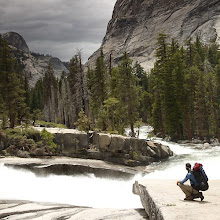
We stayed up photographing past sunset and wandered back in the dark with the most brilliant dispay of stars I'd seen in a long time. A few days later I wandered back and photographed a beautiful waterfall in the same area.  Being buried in the wet, mossy forests makes me miss the Northwest, with its drizzle and slugs, coffee houses and evergreens it will always be home for me regardless of where I reside.